OSCILLOSCOPES · REVIEWS, COMPARISONS AND GUIDES
Oscilloscopes: Reviews, Comparisons and Buying Guides
Choose an oscilloscope by the signals you need to see: enough bandwidth for your fastest signals, a sample rate well above that bandwidth, enough channels to compare signals side by side and enough memory to capture them at full speed. For most hobby and repair benches, a four-channel scope in the 50 to 200 MHz range covers the work.
Start with our ranked list of the best beginner oscilloscopes, pick by job (audio, automotive, power supplies, embedded), compare two scopes head to head, or use the guides when a trace won't trigger, drifts or shows the wrong voltage.
OUR TOP PICKS
The oscilloscopes we recommend first
The top of our ranked roundup. A Hands-on Tested badge means we bought and tested that exact unit; every other pick is spec-verified research.
- #1
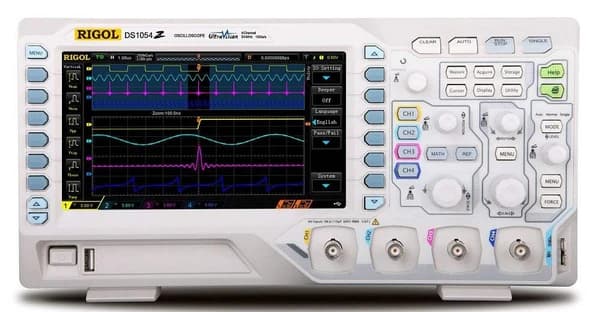 Best OverallHands-on Tested
Rigol DS1054Z
4.8★★★★★The default beginner oscilloscope recommendation for years, and still worth it.
Best for: Hobbyists, students, general electronics
- #2
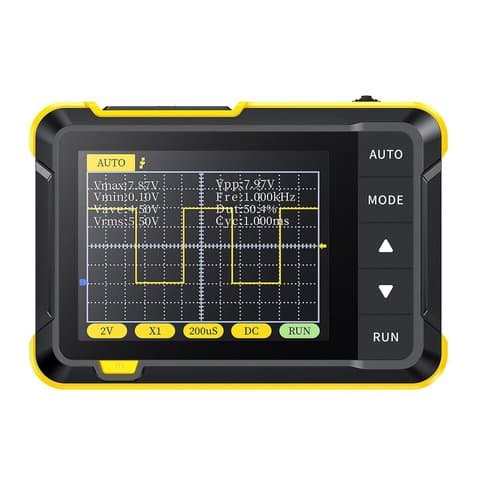 Best Budget
FNIRSI DSO152
4.1★★★★☆A genuinely pocket-sized scope for quick diagnostics — not a bench replacement.
Best for: Basic diagnostics, learning the fundamentals
- #3
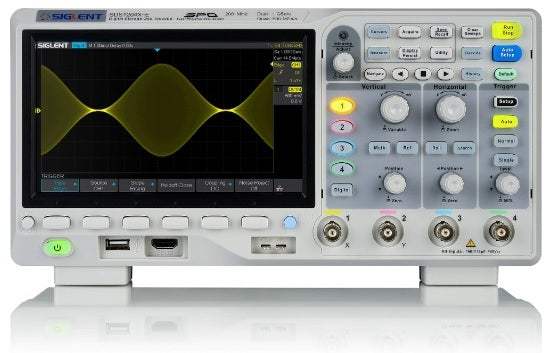 Best for Growing IntoHands-on Tested
Siglent SDS1104X-E
4.8★★★★★More bandwidth and a better UI than the Rigol, for projects that will get more demanding.
Best for: Intermediate hobbyists, future-proofing
- #4
 Best Compact Bench Option
Hantek DSO2D10
4.3★★★★☆An oscilloscope and waveform generator in one unit — practical for space-limited benches.
Best for: Space-limited benches, combined testing
- #5
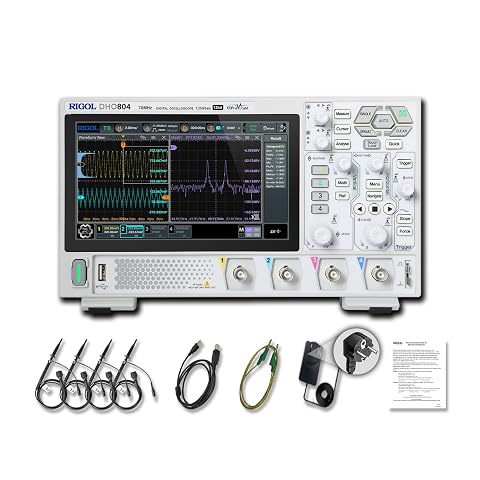 Best 12-bit UpgradeHands-on Tested
Rigol DHO804
4.8★★★★★Four channels, 12-bit resolution and a 7-inch touchscreen in a compact body that runs from USB-C power.
Best for: Hobbyists who want 12-bit detail and a touchscreen
- #6
 Best 2-Channel Rigol
Rigol DS1102Z-E
4.4★★★★☆Rigol's two-channel, 100 MHz benchtop with deep memory, for people who never need a third or fourth channel.
Best for: Two-channel debugging, students
BEST FOR YOUR JOB
Best oscilloscopes by job and budget
Start from what you'll actually use it for. Each list ranks verified picks for that one job.


HOW TO CHOOSE
What matters when you buy a oscilloscope
The specs that decide whether a tool suits your work, in the order we weigh them.
- 01
Bandwidth for your fastest signals
Bandwidth is the frequency at which the scope's response has fallen by 3 dB, about 30% in amplitude. A common rule of thumb is three to five times the highest frequency you need to see accurately, more for sharp digital edges, whose harmonics reach far above the clock rate.
- 02
Sample rate well above bandwidth
The sample rate sets how finely the scope slices the waveform in time. Aim for several samples per period of your fastest signal; many makers pair 100 to 200 MHz scopes with 1 GSa/s or more. Remember that the rate is often shared, so it can drop when you turn on more channels.
- 03
Two channels or four
Two channels are enough to compare an input and an output. Four channels make it far easier to debug digital buses, motor drives and power supplies, where you want clock, data, enable and supply rail on screen together.
- 04
Memory depth
Memory depth decides how long the scope can record at full sample rate. Shallow memory forces the sample rate down on long captures, hiding glitches; deep memory, measured in millions of points, lets you zoom into a long capture without losing detail.
- 05
Vertical resolution
Most scopes digitize at 8 bits, or 256 levels across the screen. Newer 12-bit models resolve 4,096 levels, which helps when you need to see small ripple or noise riding on a larger signal.
- 06
Features you'll use
Serial decoding (UART, I²C, SPI, CAN), FFT, automatic measurements, a built-in signal generator and USB or LAN control all save time. Check which ones are included and which need a paid license or upgrade.
IN-DEPTH REVIEWS
Oscilloscope reviews
One product per page: verified specs, strengths, limits and who should buy it.
Rigol DS1054Z Review
A closer look at our Best Overall pick
Read the review →FNIRSI DSO152 Review
Our Best Budget oscilloscope pick
Read the review →Siglent SDS1104X-E Review
Our pick for growing into
Read the review →Hantek DSO2D10 Review
Our compact bench oscilloscope pick
Read the review →HEAD TO HEAD
Oscilloscope comparisons
Two close rivals, spec by spec, with a clear answer on which one to buy for your work.
Rigol DS1054Z vs Siglent SDS1104X-E
50MHz value vs. 100MHz headroom
See the comparison →Rigol DS1054Z vs Hantek DSO2D10
4 channels vs. a scope + generator combo
See the comparison →Rigol DS1054Z vs FNIRSI DSO152
4-channel bench scope vs. 200kHz pocket scope
See the comparison →FNIRSI DSO152 vs Hantek DSO2D10
Pocket 200kHz vs. 100MHz with a generator
See the comparison →FNIRSI DSO152 vs Siglent SDS1104X-E
200kHz pocket scope vs. 100MHz 4-channel bench
See the comparison →Hantek DSO2D10 vs Siglent SDS1104X-E
Same 100MHz: generator vs. 4 channels
See the comparison →- Rigol DHO804 vs Rigol DS1054Z
- Siglent SDS1104X-E vs Siglent SDS1202X-E
- Rigol DS1102Z-E vs Siglent SDS1102CML+
- Hantek 2D72 vs FNIRSI 2C53T
- PicoScope 2204A vs Digilent Analog Discovery 3
- Rigol DHO804 vs Hantek DSO2D10
- Rigol DS1054Z vs OWON SDS1102
- FNIRSI DSO-TC3 vs FNIRSI DSO152
- Rigol DHO802 vs Hantek DSO2D10
- FNIRSI 1014D vs FNIRSI DSO-TC3
- Rigol DS1054Z vs OWON VDS1022I
- Hantek DSO5102P vs Rigol DHO804
- Rigol DHO802 vs Rigol DS1054Z
- Rigol DHO804 vs Siglent SDS1104X-E
- Rigol DS1054Z vs Siglent SDS1202X-E
- Rigol DS1054Z vs Hantek DSO5102P for Arduino
- Rigol DHO802 vs FNIRSI DSO152
- Siglent SDS1104X-E vs Hantek DSO5102P
- Rigol DHO804 vs FNIRSI 1014D for Beginners
- Siglent SDS1202X-E vs Hantek DSO2D10
- Siglent SDS1104X-E vs Rigol DHO802 for Arduino
- Rigol DHO804 vs Siglent SDS1202X-E for a Home Lab
- Rigol DHO914 vs Rigol DHO804
- Rigol DHO914S vs Siglent SDS1104X-E for a Home Lab
- Rigol DS1104Z-S Plus vs Siglent SDS1104X-E
- Hantek DSO2C10 vs Hantek DSO2D10
- OWON HDS2202S vs FNIRSI DSO152
- FNIRSI DSO152 vs Hantek 6022BE
- OWON VDS1022I vs Hantek 6022BE
- PicoScope 2206B vs Hantek 6022BE
LEARN AND TROUBLESHOOT
Oscilloscope guides and troubleshooting
Step-by-step measurements, fixes for the faults people actually hit, and the specs explained in plain English.
How to measure and test
- How to Read an Oscilloscope Screen
- How to Measure Voltage With an Oscilloscope
- How to Measure Frequency With an Oscilloscope
- How to Trigger an Oscilloscope
- How to Compensate an Oscilloscope Probe
- How to Measure Ripple Voltage
- How to Measure PWM Duty Cycle
- How to Measure Phase Difference on an Oscilloscope
- How to Trigger an Oscilloscope on a Falling Edge
- How to Compare Input and Output Signals on an Oscilloscope
- How to Capture a Brief Voltage Spike With an Oscilloscope
- How to Measure Mains Frequency With an Oscilloscope
Troubleshooting
- Why Does My Oscilloscope Show a Flat Line When a Signal Is Present?
- Why Does an Oscilloscope Show the Wrong Voltage?
- Why Does My Oscilloscope Waveform Look Distorted?
- Why Is My Oscilloscope Frequency Reading Unstable?
- Why Is My Oscilloscope Trigger Not Working?
- Why Is There No Signal on One Oscilloscope Channel?
- Why Does an Oscilloscope Waveform Look Noisy?
- Why Does Connecting an Oscilloscope Probe Change the Signal Being Measured?
- Why Does an Oscilloscope Waveform Shift Vertically?
- Why Does an Oscilloscope Show Different Voltage Readings from a Multimeter?
FAQ
Oscilloscopes FAQ
Quick answers to the questions buyers ask most. Each links on to the full guide.
01How much oscilloscope bandwidth do I need?
Use the rule of thumb of three to five times the highest frequency you want to measure accurately. Audio and most hobby microcontroller work fit comfortably within 50 to 100 MHz. Fast digital edges, switching power supplies and RF need more, because sharp edges contain harmonics well above the base frequency. More bandwidth also shows more noise, so buy for your real signals.
02Is a two-channel oscilloscope enough for a beginner?
Two channels are enough to learn on and to compare an input with an output. Four channels make debugging much easier once you work on digital communication, motor control or power supplies, where several signals interact. Many entry-level scopes now come with four channels, so plenty of beginners choose four from the start.
03Are handheld or pocket oscilloscopes worth buying?
Handheld scopes are handy for automotive and field work, and some combine a scope with a multimeter. Most have less bandwidth, fewer channels, shallower memory and smaller screens than bench scopes. For learning electronics at a desk, a bench scope is usually the better tool; for portable diagnostics, a handheld can be the more practical choice.
04What is the difference between an 8-bit and a 12-bit oscilloscope?
Bit depth is vertical resolution. An 8-bit scope divides the screen into 256 levels, a 12-bit scope into 4,096, so it resolves smaller changes in voltage. That helps when you look for millivolts of ripple or noise riding on a larger signal. For general digital and timing work, a good 8-bit scope is still perfectly capable.
05Do I need an oscilloscope if I already have a multimeter?
A multimeter gives you a single number, such as an average or RMS voltage. An oscilloscope shows how the voltage changes over time, which reveals ripple, noise, glitches, timing and signal shape that a meter cannot. If you repair or design electronics beyond simple DC circuits, a scope is the next tool to add.
06Why do oscilloscope probes have a 1x/10x switch?
In 10x mode the probe divides the signal by ten, which loads the circuit far less and gives the full probe bandwidth. 1x mode keeps full sensitivity for very small signals but has much lower bandwidth and heavier loading. Always set the scope channel to match the probe, or every voltage reading will be off by a factor of ten.